
Golf & Brain Special - day 1. What your brain really does during a golf swing
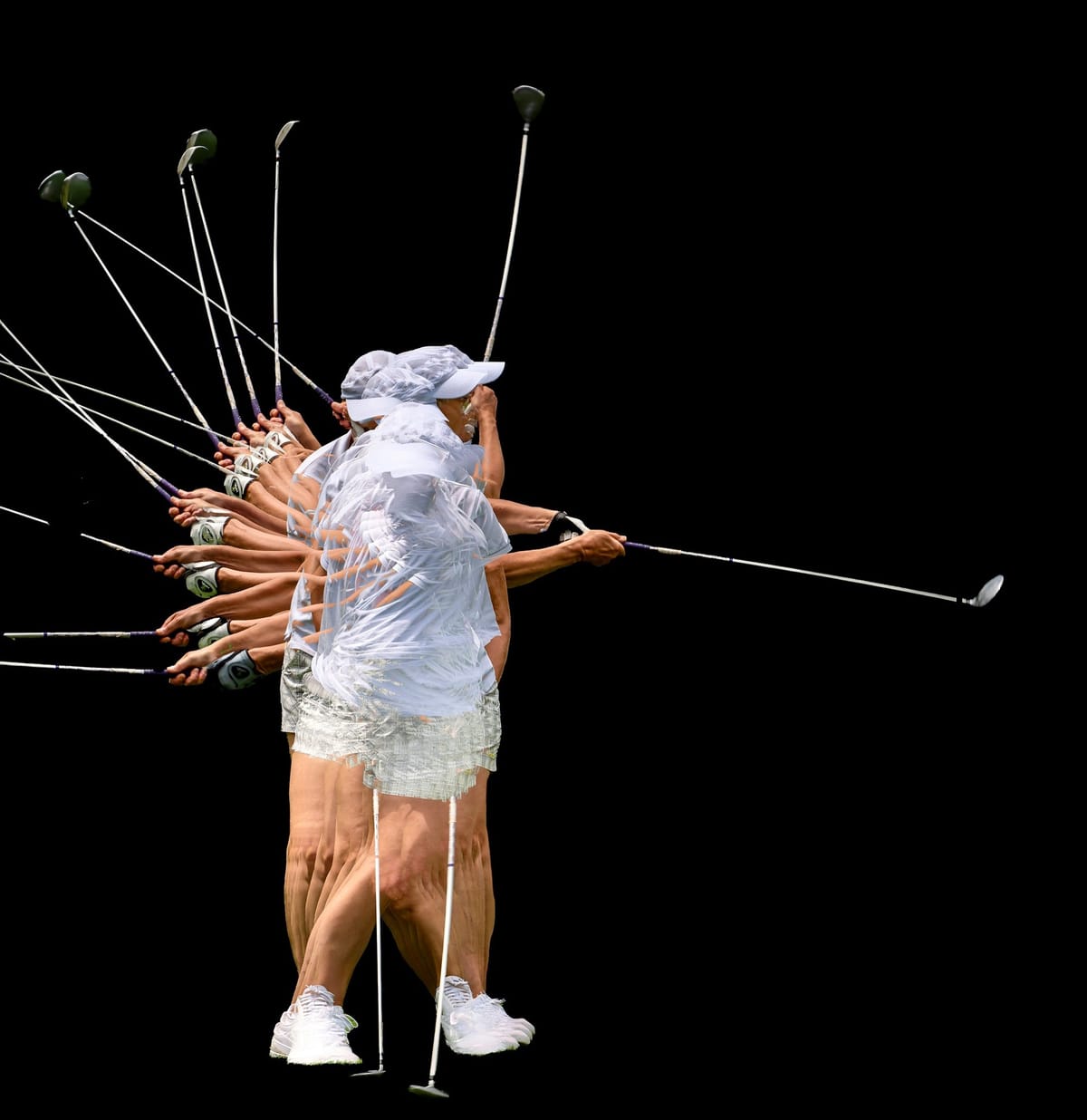
Every golfer knows the quiet moment before starting a swing. Your body is still, but your mind is anything but. Neuroscience shows that this early phase is packed with hidden activity.
It turns out that during a golf swing, your brain goes through two distinct phases: the prediction phase and the striking phase - and that the mind’s swing is as complex as the physical swing.
Prediction phase - The golf simulator in your mind
Long before muscles fire, the brain is already simulating what is about to happen. It builds a mental preview of the swing based on past shots, learned technique, and the expected feel of the impact. You can think of it as your brain running a mental simulation before you move your muscles.
This internal preview is not just a vague idea. It involves specific brain networks that are well known to scientists who study how we observe movement.
These networks switch on when you watch someone doing something you are familiar with. Football players have stronger brain activity when they watch football clips, dancers light up when they watch choreography, and golfers do the same when they watch swings.
The main brain regions involved are the motor and parietal cortices, the sensory cortex, and the cerebellum. Together they form a kind of “simulation team”. When a golfer is brain-scanned while watching a swing, these brain areas wake up as if the observer is preparing to swing the club themselves.
During this preparation phase, elite golfers show strong activity in regions that help the brain track internal sensations and predict how the swing will feel. Their simulations are richer and more detailed because years of practice sharpen the brain’s internal models.
So, even though nothing has happened yet, the swing has not begun, the brain is already rehearsing. It sets up expectations based on thousands of stored memories of how a good swing feels, how the club moves through space, and what the ball flight should look like.
This is why the early phase of the swing feels deeply internal, almost meditative. Some would call it mentally loaded instead of meditative..
Striking phase - The brain shift when the swing starts
Everything changes once the club begins to move. The moment the downswing starts, the brain switches from quiet prediction to intense sensory processing. This is the striking phase: the most mechanically challenging part of the swing and the one that separates a good shot from a bad one.
When elite golfers watch this part of a swing, the somatosensory cortex (brain cells on the brain surface) becomes much more active than it does in novices. This area is responsible for processing touch and body position.
For experts, watching a downswing is enough to trigger the sensation of how the body should feel during impact. It is as if the brain is momentarily “inside” the movement, tracking the imagined feel of the club head.
The cerebellum also comes online more strongly during this phase. It plays a key role in timing, coordination, and fine motor control. When watching the moment of contact, experts show cerebellar activity that suggests their brains are running a fast internal check: does the imagined movement match my prediction? Would the shot be clean? Would the face angle be right?
This phase-specific pattern shows that the brain does not treat a golf swing as one long movement. Instead, it treats it as a sequence of events with different demands. The preparation phase is all about forecasting. The striking phase is about evaluating fine details.
Experts shift between these mental states automatically. They simulate the swing with more detail than the rest of us, and they do so at exactly the moment the real swing would demand it.
Your brain is comparing predictions to imaginary feedback
Another important part of this research looked at how different brain regions communicate during each swing phase. Scientists focused on the primary somatosensory cortex, which is a key “body information hub”. They studied how this area connects with others, depending on which part of the swing was being observed.
A unique pattern appeared during the striking phase. Expert golfers showed stronger communication between the somatosensory cortex and a part of the brain (the precuneus) involved in mental imagery and building a sense of the body in space. This link suggests that experts bind imagined sensations to a mental picture of their own body at the exact moment when precision matters most.
In simpler terms, the brain blends imagined touch with imagined body position to fine-tune the strike. For seasoned players, the brain forms a short-lived bridge between sensation and imagery, specifically during the moment of contact. This is not something novices show to the same degree. So sorry, no easy way around the “1000” hours on the driving range.
This finding fits with research in other sports. What makes golf interesting is that these changes are tightly tied to the timing of the swing. The brain tightens this communication only when it matters: in the milliseconds when the club meets the ball.
From the perspective of predictive neuroscience, this makes perfect sense. The moment of impact is full of uncertainty. Small changes in wrist angle, club speed, or timing can drastically alter the shot.
The brain, therefore, increases the precision of its sensory predictions and strengthens internal communication channels. This allows experts to mentally “feel” the shot even when they are only watching.
Why this matters for training and performance
This research makes it clear that training changes not just how strongly your brain works, but how flexibly it works. Experts do not simply activate more brain regions than novices. They activate different brain regions at different times.
What is also clear is that the brain handles a golf swing as a finely timed sequence. When you prepare, the brain predicts. When you swing, the brain evaluates. When the ball is struck, the brain tightens communication between sensation and imagery. This mental choreography underlies the smooth, powerful, and consistent swings we associate with elite performance.
Though the study used passive video watching rather than live swings, the findings reveal the deep mental structure of golf. That has clear implications for training.
By strengthening the brain connection, both novice and elite golfers may enhance the accuracy of the inner simulation model we use to predict and evaluate the strike.
Drills that highlight impact, such as controlled slow swings or exaggerated follow-through work, might plug directly into the golf-brain. Visualising posture and rhythm, slow-motion review, and mental rehearsal may improve your swing on the golf course.
Even visual training, like watching the PGA Tour on TV, might improve your golf handicap. These images feed directly into the brain's golf circuits. This also means that during a day with heavy rain or thunderstorms, you can still practice your golf swing at home on the sofa.
We did suspect that golf was a "mind-game", but that may be an understatement.
About the paper that inspired:
First author: Xueyun Shao, China
Published in: Brain Sciences, November 2025
Link to paper: https://www.mdpi.com/2076-3425/15/11/1215



Comments ()